Penetration Thresholds in Multi-Deck Blackjack and Their Influence on Session Performance
 Multi-deck blackjack games rely on shoes containing six or eight standard decks, and penetration refers to the percentage of cards dealt before the dealer inserts the cut card and reshuffles; this metric directly shapes the statistical environment players encounter during extended sessions. Research from gaming laboratories indicates that penetration levels typically range from 60 to 85 percent in regulated venues, with each threshold altering the frequency of favorable card distributions that emerge as play progresses. Data compiled by the Nevada Gaming Control Board shows that deeper penetration correlates with increased opportunities for tracking remaining high-value cards, whereas shallower cuts limit those windows and compress potential advantages across multiple hands. Observers note that a 75 percent penetration threshold often serves as a benchmark in six-deck configurations because it allows sufficient cards to be removed before reshuffling occurs, thereby extending the duration of any imbalance in the remaining deck composition. When penetration falls below 65 percent, session simulations conducted by independent research groups reveal that positive expectation periods shorten considerably, which in turn elevates the role of variance in determining net results over a fixed number of hands. Conversely, penetration reaching 80 percent or higher expands those windows, permitting more hands to be played while the composition favors certain strategic adjustments derived from basic probability tables.
Defining Key Penetration Thresholds Across Common Shoe Sizes
Analysts categorize penetration into distinct bands that reflect measurable differences in expected card flow, and these bands interact with rules such as dealer hit or stand on soft 17 to produce varied session trajectories. In eight-deck shoes, for instance, a cut at the 70 percent mark leaves roughly two and a half decks unseen, a volume that statistical models associate with modest shifts in high-card density during the latter stages of each round. Studies published through academic gaming programs demonstrate that moving from 65 to 75 percent penetration increases the number of hands eligible for count-based deviations by approximately 20 to 30 percent, depending on the specific counting system employed.
Thresholds near 85 percent appear less frequently in commercial settings yet produce the longest stretches of continuous play under a single shoe composition, which researchers link to wider dispersion in session outcomes when measured across hundreds of trials. Those who examine large datasets from controlled environments find that each incremental five percent gain in penetration extends the average length of favorable segments by several additional rounds before reshuffling resets the distribution.
How Penetration Alters Session Outcome Distributions
Session outcomes in multi-deck blackjack encompass the aggregate win or loss recorded over a predetermined number of hands or time interval, and penetration influences these aggregates primarily through its effect on the timing and magnitude of count fluctuations. When penetration exceeds established thresholds, the probability of encountering extended sequences of high or low cards rises, which data from university-led Monte Carlo simulations connect to broader standard deviations around the mean return. Shallower penetration, by contrast, truncates those sequences and tends to anchor results closer to the long-term house edge embedded in the ruleset.
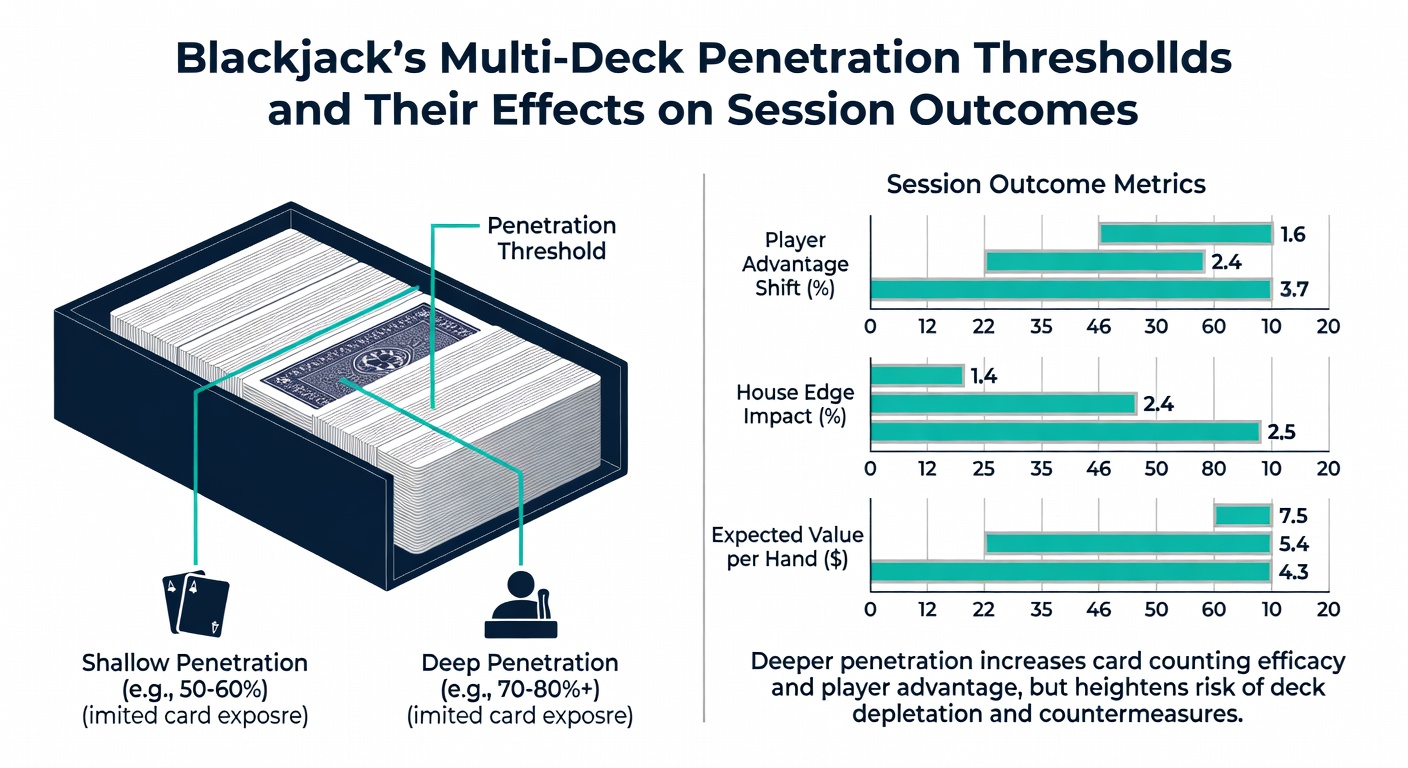
Figures released by the Ontario Lottery and Gaming Corporation indicate that monitored tables operating at 78 percent penetration recorded session standard deviations approximately 12 percent higher than those observed at 62 percent penetration under comparable bet spreads. This elevation in dispersion does not alter the underlying mathematical expectation but redistributes the frequency with which sessions terminate above or below break-even points. Players who maintain consistent wager sizing across many rounds therefore encounter wider swings in cumulative results as penetration deepens, a pattern confirmed in multiple longitudinal tracking studies.
Interaction Between Penetration and Rule Variants
Rule variations such as double after split permissions or surrender options modify the baseline value of each hand, yet their interaction with penetration thresholds determines how those modifications scale across an entire session. Evidence gathered from regulatory compliance reports shows that games offering late surrender combined with 75 percent penetration allow more opportunities to exit negative hands during unfavorable segments, which in turn dampens downside variance without changing the core penetration effect. In jurisdictions where such rules coexist with deeper cuts, session data sets reveal tighter clustering of outcomes around the adjusted expectation compared with no-surrender counterparts at identical penetration levels.
What's interesting is the way penetration thresholds also influence the practical application of strategy deviations that depend on remaining deck composition, because shallower cuts reduce the number of hands played at any given true count and thereby limit the cumulative impact of those adjustments. Researchers who aggregate results across multiple casino floors note that the same counting methodology yields measurably different session histograms when applied to 68 percent versus 82 percent penetration environments, even when all other parameters remain constant.
Conclusion
Penetration thresholds in multi-deck blackjack establish the structural boundaries within which session outcomes unfold, and quantitative examinations consistently demonstrate that incremental changes in cut depth produce corresponding shifts in the distribution of results over repeated play. Regulatory records and academic modeling together establish that deeper penetration extends the intervals during which deck composition deviates from the initial average, thereby modulating both the frequency and scale of departures from expected value. These documented relationships continue to inform operational decisions across regulated markets as new data accumulates through ongoing compliance monitoring and independent analysis.