Calculating the Odds: Side Bets' Role in Altering Expected Values for Blackjack Variants
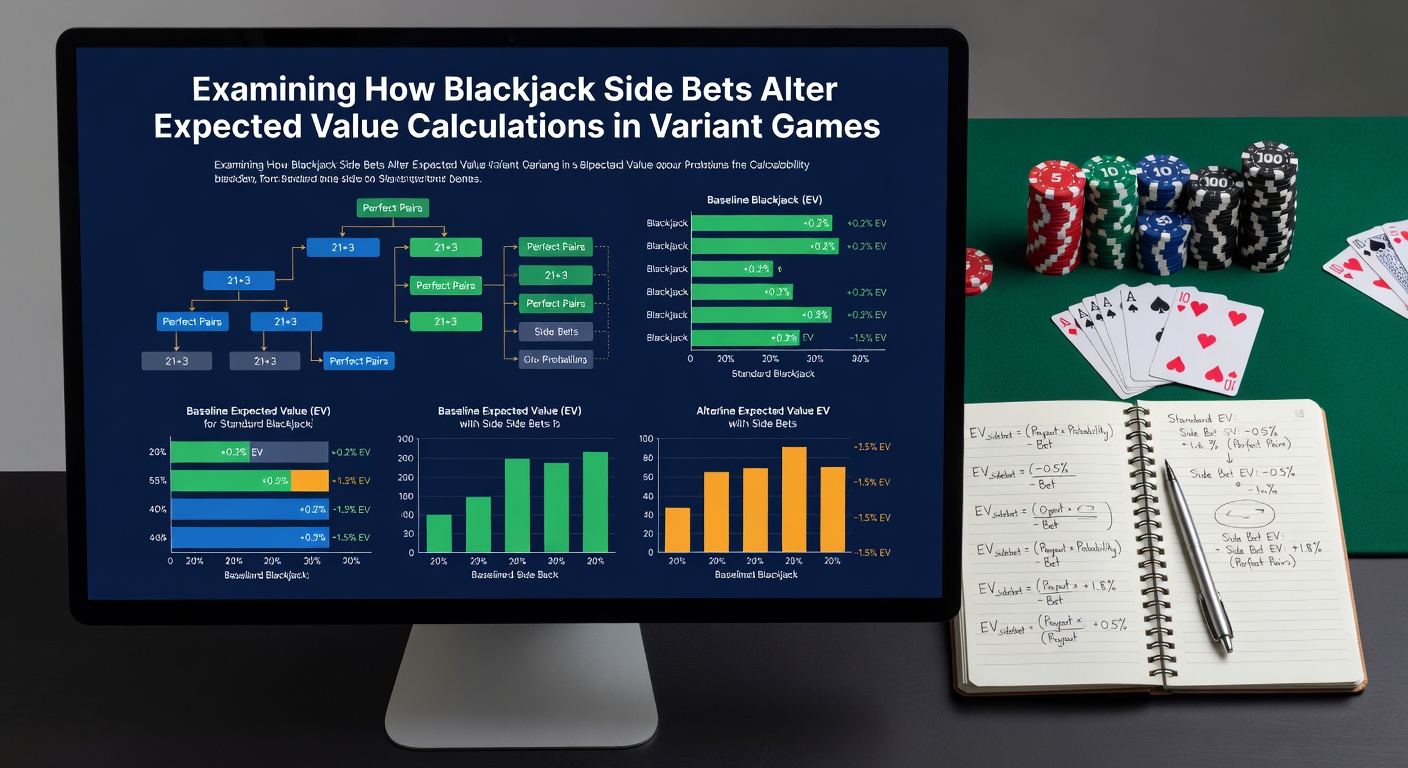
Blackjack variants introduce side bets that shift the core expected value calculations players rely on when assessing long-term outcomes. These additional wagers sit outside the primary hand, yet they draw from the same deck composition and payout structures, which means the math changes in measurable ways. Observers note that side bets often carry house edges ranging from 2 percent to over 10 percent depending on the specific option and game rules in play.
Expected value itself represents the average result a bet would produce over many repetitions when probability and payout combine into a single figure. In standard blackjack the base game hovers near even or slightly negative EV under optimal play, yet side bets pull that figure further into negative territory because they typically offer fixed payouts against dynamic probabilities that favor the house. Researchers who model these scenarios use combinatorial analysis to count favorable card combinations against the total possible outcomes, and the resulting EV formulas incorporate both the main hand and any simultaneous side wagers.
Core Mechanics Behind Side Bet Integration
Side bets activate on the first two cards dealt or on specific card combinations that appear during play, and their presence alters deck depletion rates in ways that affect subsequent hands. Take the popular 21+3 side bet, which pays according to poker-style combinations formed by the player's two cards plus the dealer upcard. Its payout structure rewards three-of-a-kind at 100 to 1 while straight flushes return 30 to 1, yet the underlying probability of hitting those exact combinations sits well below the payout ratio, producing a consistent negative EV. Variant games such as Spanish 21 remove all tens from the deck, which further modifies those same probabilities and forces recalculated EV tables for every side bet attached to the ruleset.
Insurance represents another common side bet that players encounter when the dealer shows an ace. This wager pays 2 to 1 if the dealer holds blackjack, yet its EV turns positive only when the remaining deck contains enough tens to exceed one-third of the unseen cards. In multi-deck variants the frequency of that condition drops, pushing the insurance EV firmly negative under most circumstances. Those who've studied this know the decision hinges on real-time composition rather than fixed strategy charts.
Variant-Specific EV Adjustments
Double-deck and single-deck games change the baseline EV of side bets because fewer cards remain unseen at any point in the shoe. A Perfect Pairs side bet, for instance, pays 30 to 1 for a mixed pair and 5 to 1 for a suited pair in some rule sets, yet the removal of even one ten or face card alters pair frequencies enough to require updated probability matrices. European variants that prohibit doubling after split and restrict surrender options compound these shifts by narrowing the player's overall decision tree while the side bet probabilities stay tied to the same initial card distribution.
Data from the Nevada Gaming Control Board indicates that table games with multiple side bet options generate higher hold percentages than base blackjack alone, reflecting the cumulative drag on player EV across all wagers placed simultaneously. Analysts track these figures through aggregated revenue reports that separate main game results from side bet contributions, revealing consistent patterns across properties that offer 21+3, Lucky Ladies, and Royal Match alongside standard rules.

Recent Developments and 2026 Projections
Industry reports show fresh blackjack variants scheduled for wider deployment in May 2026 that incorporate dynamic side bets tied to progressive jackpots or community bonus rounds. These additions require entirely new EV models because the jackpot component introduces variable payout pools that fluctuate with player volume and seed amounts. According to research compiled by the Alcohol and Gaming Commission of Ontario, such hybrid bets further distance overall player return from the base game EV, especially when the progressive trigger probability sits below 0.001 percent.
Combinatorial software used by gaming laboratories now runs millions of simulated shoes to isolate the marginal impact of each side bet on total EV. One study revealed that attaching three simultaneous side bets to a six-deck Spanish 21 game can push the composite house edge above 4 percent even when the main hand remains under 1 percent. Those figures emerge only after exhaustive enumeration of every possible two-card and three-card outcome across the modified deck.
Strategic Implications for Players and Operators
Players who track side bet EV separately often discover that skipping these wagers preserves the closest approximation to the theoretical return of the base game. Yet the appeal of larger payouts continues to drive participation rates, which operators monitor through table-level analytics that compare side bet handle to main game handle. The resulting data sets help refine minimum and maximum limits so that volatility stays within acceptable ranges for both the house and the player pool.
Game designers who introduce new side bets must balance payout tables against regulatory requirements for disclosed house edges. This process involves iterative testing where each rule tweak receives fresh EV verification before approval. Observers note that transparent disclosure of these calculations appears in game rules pamphlets and on-screen displays at electronic tables, giving players access to the same mathematical framework used by compliance teams.
Conclusion
Side bets in blackjack variants systematically modify expected value calculations by layering additional probability distributions onto the base game framework. The cumulative effect appears in revenue reports, laboratory simulations, and updated strategy resources that account for simultaneous wagers. As new variants reach the market in 2026, these mathematical relationships will continue to shape both player decisions and operator offerings through precise, data-driven adjustments rather than fixed assumptions about game value.